Introduction
Are OOP concepts confusing you? 😵
Don’t worry — in this Article, I’ll explain Java OOP in the simplest way possible with real-life examples.
What is OOP
OOP stands for Object-Oriented Programming.
It’s a way of writing code using objects and classes instead of just functions.
Why use OOP?
✔ Better code structure
✔ Reusability
✔ Easier maintenance
Encapsulation
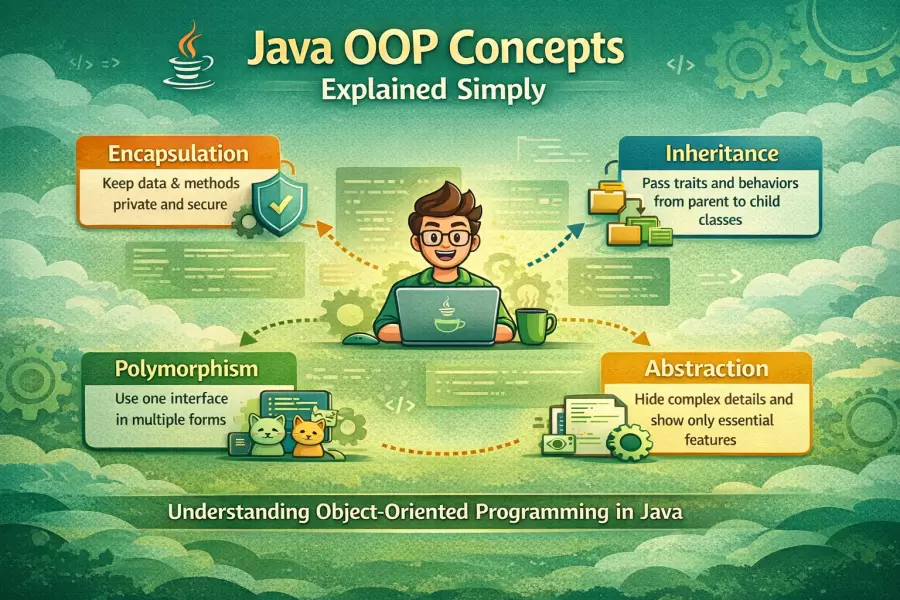
Encapsulation means wrapping data and methods into a single unit — a class.
In Java:
👉 Use private variables
👉 Access them via getters/setters
💡 Real-life example:
A capsule 💊 — you don’t see what’s inside, but it works.
Inheritance
Inheritance allows one class to use properties of another.
Example:
👉 Parent class: Animal
👉 Child class: Dog
Dog can use methods like eat() from Animal.
💡 Real-life: child inherits features from parents.
Polymorphism
Polymorphism means ‘many forms’.
Same method behaves differently depending on context.
Types:
✔ Method Overloading (compile-time)
✔ Method Overriding (runtime)
💡 Example:
draw() for circle vs square.
Abstraction
Abstraction hides complex details and shows only essentials.
In Java:
👉 Abstract classes
👉 Interfaces
💡 Real-life:
You drive a car 🚗 without knowing how the engine works
Real-world Example
Let’s combine everything:
Car system:
✔ Encapsulation → data inside class
✔ Inheritance → ElectricCar extends Car
✔ Polymorphism → start() behaves differently
✔ Abstraction → user only sees controls
Conclusion
To summarize:
✔ Encapsulation → data hiding
✔ Inheritance → reuse code
✔ Polymorphism → flexibility
✔ Abstraction → simplicity
Tags
Want a complete structured Java learning path?
Explore our courses and bundles designed for clarity and real backend learning.
Browse Courses View Bundle